Pre-script: I got this idea in 2025. It has taken me an entire day, i.e., today, the day of publishing, almost a year after I got the idea, to get it from my head to the paper.
Once you leave home at an early age, going home, finding home, and building a home become recurring themes of your character arc and a lifelong journey you unintentionally embark on. Moments, people, experiences, places, trees, birds, corners, windows, food, books, the way sunlight enters a room on a lazy morning, the way the moon always asks you to look at it from a window, the shadows of a tree on your running route, the gulmohar you see on your commute, walking long trails in the mountains, the smell of a तड़का (tempering), the sound of अगं – all remind one of home. The feeling of being home and reclaiming home.
Many moons ago, Virgina didi made the case for having a room of one’s own. She wrote it as a feminist manifesto, from her position of immense privilege. For late bloomers like me, I want to make a case for a कपाट of one’s own. For different reasons.
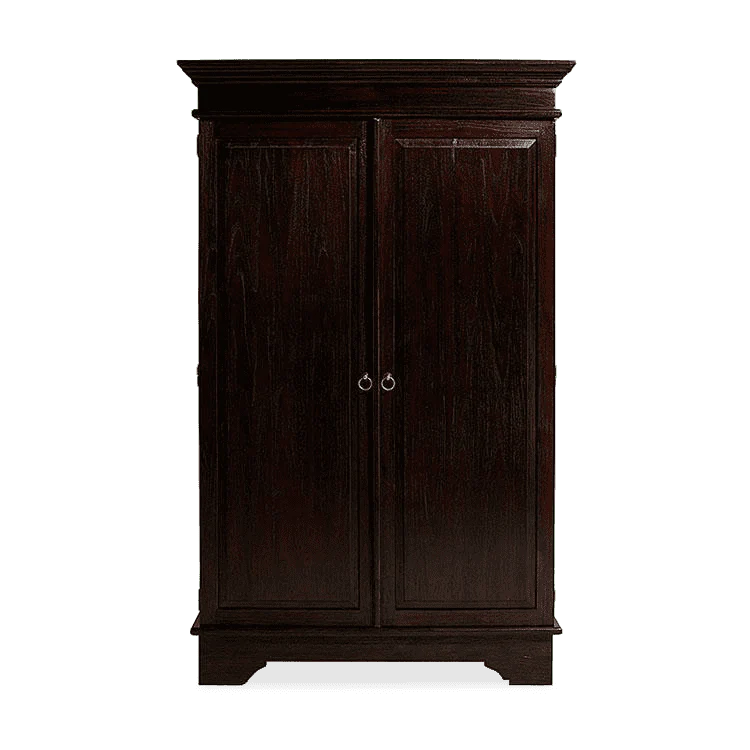
My grandfather owned a wooden cabinet – for the lack of a picture of the original, imagine something similar to the one on the right. It was deep mahogany, teak wood (सागवान) with equally spaced horizontal shelves inside. It wasn’t this tall. After standard 5, I was easily able to stand beside it and no longer use the space on the other side as a hiding spot. As he was a minimalist, from what we knew, all his belongings resided in this कपाट. Even my आजी had no right over any of its shelves. This was the one piece of furniture that belonged to him and only him. He kept the key with him when going out. When inside the house, it hung by its side. It contained his numerous books, diaries, clean sets of clothes arranged neatly, and other stationery. I am guessing all this. I never peeked inside or felt curious to ask how he acquired it. We all knew he wasn’t into material things. But he was into owning his कपाट and space in a large, shared household with many rooms and occupants.
I don’t know when the seed of having a कपाट of my own entered my head. Growing up, I always shared कपाट with my brother. In a family of 5 living in a limited space, this was a no-brainer. Despite the numerous fights over stuff creeping into each other’s territory, aka shelves. It was more than enough to be honest. I never felt the need to want more.
When I moved away from home into another shared space – the hostel, I got a reality check. In the first year, I shared a room with 3 other girls. Because of some silly geographical detail of coming from a part of the state that was not considered the majority, I was the 4th person in a room designed for 3. It meant even tho I got a bed of my own, I would not get a कपाट of my own. My roommates, of their own accord and generosity, had offered to share their कपाट space with me. So I divided my limited belongings into 3 कपाटs for a year. Starting my second year, I became part of the majority by securing the best marks. I paid it forward to the other 4th girl for the next 3 years. The important detail being I had a कपाट of my own! The character arc from majority to minority to majority also feels like something out of a history book. No?
My grandfather passed away when I was studying in the US. One day he was here, the next day he was gone. By this time, I had an entire sliding कपाट to myself. My belongings had also increased. There was winter wear, summer wear, Indian wear, formal wear, home wear, shoes, socks, books, notes, and other paraphernalia that people who move cities or countries gather. Despite appearances. I don’t remember asking anyone what happened to his कपाट. I remember longing for it tho. A longing for home. No wonder I could not live in another country for long. Alas!
As someone who has had her fair share of living in different spaces and using कपाटs designed and built by others, I can confirm that they have seen me. The yearly cleaning, cluttering, decluttering, and donating rituals included. They have even seen a phase of obsessive organizing, in the form of amazon bought organizers. From someone whose belongings could be packed into two bags when leaving a country to someone who has run out of space after 3 कपाटs, there has been another character arc development. A person who doesn’t outgrow things but ends up keeping them in her life. Some will say, I can’t let go. I say I am a collector and memory keeper. Moreover, I choose not to listen to such people.
In 2025, though, this character arc took an unexpected turn. My growing roots in this city started craving an anchor. How long can one stay in deep waters and not long for the familiarity of the shore? Even perpetual outsiders want to belong. Dear reader, one must pay heed to such things. Such arcs can be life-defining. Or changing. Who knows?
आजोबा’s कपाट became that invisible anchor from my memory. I bought a teak wood कपाट similar to his after a lot of searching. From vintage shops to online catalogs, I hunted all that’s out there. It was a hunt, ok? Someone’s color was a match, but height wasn’t. Someone was too pricey, someone felt fake. I even went to a carpenter to see if it would be easier to get something custom-made. I discarded that idea, as it was too impractical and I was too impatient and naive to understand woodworking details. In all this, I also questioned myself why I did not claim आजोबा’s कपाट when I had the chance? It was, in a way, too late and impractical. It’s the algorithms, maybe (?), who helped me arrive at a decision. The sign from the universe, aka targeted ads, where I kept on seeing that one कपाट on every online excursion. I bought ‘the one’. (It was more of a choice made for me by the ad gods, but I would like to believe I made the choice).
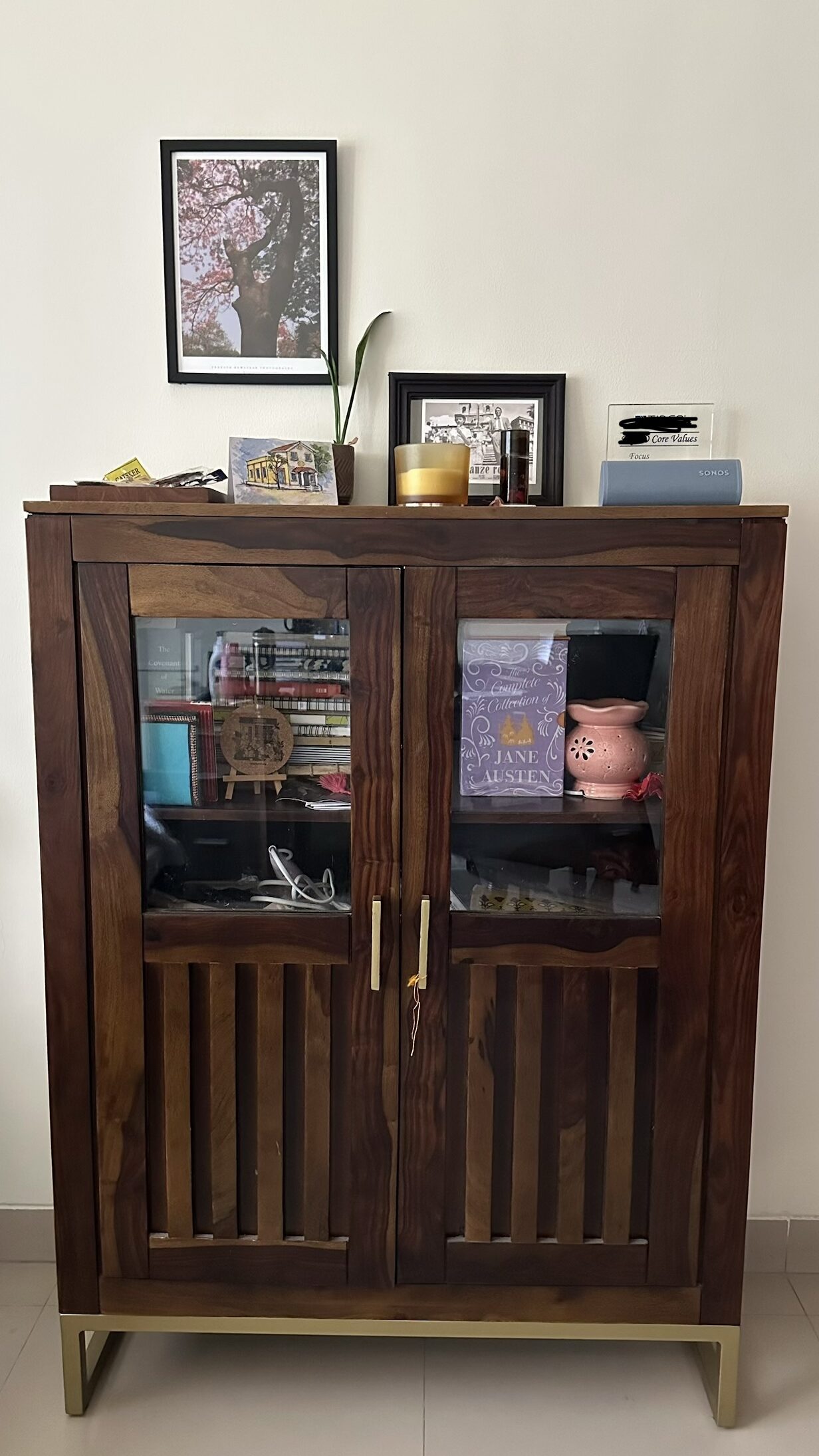
After a month-long wait, it was delivered to my doorstep. It was wrapped delicately from foot to toe to protect its sturdy parts. The unwrapping took me an hour. Thankfully, it came pre-assembled, so I only had to move this quite heavy piece to its desired (by me) location. I had some choice after all! I don’t know if it’ll ever serve a practical purpose beyond housing some of my belongings collected over the years. The wooden part of the door hides the messy details, and the glass upper front gives an aesthetic peek. The point of being an adult on some days is seeing the child within you go back home. Feel at home. On an existential level, the कपाट might feel underutilized as a piece of furniture. On a purpose level, it has already started serving its purpose. I know how corporate-y this sounds.
And whoever inherits it, through some luck or line of ascension (pls don’t laugh), will have this longish origin story to read. They could have a ‘A कपाट of one’s own’ that would become the keeper of their home and stories. Romanticize life even.


Leave a Reply